
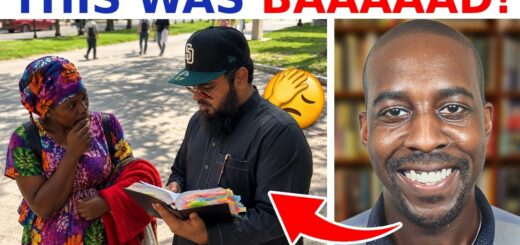
Muslims Debate Christians & Get DEMOLISHED (It Was Brutal)!
One of the most common objections raised by Muslim apologists is that the Bible has been corrupted over time. During a recent discussion between Christians and Muslims, that familiar claim surfaced once again.
But as the conversation continued, the focus shifted from the Bible to the Quran itself.
The Christians repeatedly asked a simple question: If the Bible was already corrupted before Muhammad, why does the Quran tell people to consult it?
That question became one of the defining moments of the debate.
 When Was the Bible Supposedly Corrupted?
Rather than allowing the discussion to remain vague, the Christians pressed for specifics. Was the Bible corrupted before Muhammad’s lifetime or afterward?
That question matters because the Quran repeatedly speaks positively about the Torah and the Gospel. If those books were already unreliable, then the Quran appears to direct people toward corrupted Scriptures.
If they were still trustworthy, then the common Muslim claim that today’s Bible has been changed becomes much harder to defend.
The debate showed that simply asserting corruption is not enough. A claim that significant requires evidence, not assumptions.
“And if thou art in doubt concerning that which We reveal unto thee, then question those who read the Book before thee. Verily the truth from thy Lord hath come unto thee. So be not thou of those who waver.” — Surah 10:94
 The Quran Tells Christians to Judge by the Gospel
Several passages from the Quran became central to the discussion.
Surah 5:47 instructs Christians to judge by the Gospel. Surah 5:68 tells the People of the Book to stand upon the Torah and the Gospel. Yet many Muslims also insist those same books cannot be trusted.
That creates an obvious tension.
If Allah commands people to judge by these Scriptures, then those Scriptures must have been reliable enough to serve as God’s standard. Otherwise, the command itself loses its meaning.
During the debate, the Christians continually brought the conversation back to this point whenever the discussion drifted into general claims about corruption.
“And let the people of the Gospel judge by that which Allah hath revealed therein…” — Surah 5:47
“Say, O People of the Scripture, ye have no ground to stand upon unless ye stand fast by the Law, the Gospel, and all the revelation that has come to you from your Lord.” — Surah 5:68
 A Clear Book Should Give Clear Answers
Another interesting moment came when one Muslim participant admitted that the Quran does not clearly identify which parts of the Bible were supposedly corrupted.
That admission raised another problem.
Surah 5:15 describes the Quran as bringing clarity. Yet if the corruption of previous Scripture is one of Islam’s most important doctrines, why does the Quran never identify which passages changed, who changed them, or when they were changed?
The Christians pointed out that we possess Biblical manuscripts dating both before and during Muhammad’s lifetime. They consistently communicate the same Gospel message found in modern Bibles.
Without evidence of an earlier, uncorrupted version, the corruption claim becomes difficult to support.
 The Gospel Always Points to Christ (Jesus Fulfilled the Old Covenant)
As the conversation progressed, the discussion moved beyond manuscript evidence and into the message of Scripture itself.
From Genesis onward, the Bible tells one unfolding story that reaches its fulfillment in Jesus Christ. The Old Testament sacrifices, priesthood, and covenant all anticipate the coming Messiah.
Paul summarizes the heart of the Gospel in 1 Corinthians 15.
“For I delivered unto you first of all that which I also received, how that Christ died for our sins according to the scriptures; And that he was buried, and that he rose again the third day according to the scriptures.” — 1 Corinthians 15:3-4
If Christ’s death and resurrection are removed, the very foundation of Christianity disappears. Yet those events are consistently proclaimed throughout the New Testament and foreshadowed throughout the Old Testament.
One of the strongest explanations during the debate concerned the relationship between the Old and New Covenants.
The discussion highlighted an important Biblical distinction. Jesus did not abolish God’s revelation—He fulfilled it.
Long before Christ came, God promised a New Covenant.
“Behold, the days come, saith the LORD, that I will make a new covenant with the house of Israel, and with the house of Judah.” — Jeremiah 31:31
Isaiah likewise foretold the coming Servant who would establish God’s covenant among the nations.
“I the LORD have called thee in righteousness… and give thee for a covenant of the people, for a light of the Gentiles.” — Isaiah 42:6
This pattern should not surprise us.
Just as Moses introduced the first covenant after the Exodus, Jesus—the greater Moses—established the New Covenant through His death and resurrection. The ceremonial requirements given through Moses pointed forward to Christ, while God’s moral standards remain.
The New Testament repeatedly explains that believers are no longer justified through ceremonial observances but through faith in the finished work of Christ.
 Grace Does Not Give Permission to Sin
Toward the end of the debate, another important issue surfaced.
Some confusion arose over whether Christians believe God’s commandments no longer matter because believers are under grace.
Scripture gives a clear answer.
“What shall we say then? Shall we continue in sin, that grace may abound? God forbid.” — Romans 6:1-2
Grace is not permission to live however we please. Rather, Christ fulfilled the ceremonial aspects of the Law while calling His followers to lives marked by holiness, obedience, and love.
That distinction helps explain why Christians no longer observe many Old Testament ceremonial practices while still affirming God’s moral commands.
 The Burden of Proof Still Remains
One of the most valuable lessons from this discussion was the importance of asking careful questions.
Instead of allowing broad accusations against the Bible to go unchallenged, the Christians consistently asked for evidence.
Where is the original Gospel that supposedly differs from today’s Gospel? When was the Bible corrupted? Which passages were changed? If the Scriptures were already corrupted, why does the Quran repeatedly direct people back to them?
Those questions remained largely unanswered throughout the debate.
Confidence in God's Word is not built on avoiding difficult questions. It is strengthened by examining the evidence honestly and allowing Scripture to speak for itself. Share on XIf you enjoyed this discussion, be sure to read our related article. It explores even more claims made about Christ and compares them carefully with both Scripture and historical evidence. You can read it here.
WATCH THE VIDEO













Recent Comments