
Christian EXPOSES SECRET FOOTAGE Of Hebrew Israelites Converting Christians!
In this discussion, a group of Hebrew Israelites and a Christian man confidently argued that Christians don’t truly believe in Christ. As the conversation unfolded, it became clear that Christianity wasn’t the issue.
The real problem was how they handled Scripture. What started as bold claims quickly turned into a clear example of what happens when people take verses out of context and force them to support a predetermined belief.
This wasn’t just a disagreement. It was a direct clash between an interpretation grounded in context and an interpretation driven by assumption.
 The Real Meaning of Revelation 1
One of the central arguments revolved around the description of Jesus in Revelation Chapter 1. The Hebrew Israelites pointed to the verse describing Jesus’ feet as “like fine brass, as if they burned in a furnace,” and used that to argue for a specific skin color.
On the surface, that might sound convincing, but the moment you read the full passage, the argument begins to fall apart.
“His head and his hairs were white like wool, as white as snow; and his eyes were as a flame of fire; And his feet like unto fine brass, as if they burned in a furnace…” – Revelation 1:14–15
The Christian didn’t deny the wording. Instead, he exposed the inconsistency. If you take the description of the feet literally to determine skin color, then you must also take the rest of the description literally.
That would mean Jesus has pure white hair and a head like snow and eyes that look like fire. Clearly, this is not a natural human description.
The passage is symbolic. It is describing Jesus in His glorified state, emphasizing His purity, authority, and divine nature. Scripture often uses imagery like this to communicate deeper truths.
“The Ancient of days did sit, whose garment was white as snow, and the hair of his head like the pure wool…” – Daniel 7:9
When the Bible speaks of whiteness in this way, it points to holiness and purity, not ethnicity. The issue in the debate was not about what the verse said but how it was being interpreted.
Once the full context was considered, the argument lost its foundation.
 The Importance of Consistency in Interpretation
As the conversation continued, the lack of consistency became even more obvious. The same logic applied to one part of the verse was not applied to the rest.
That kind of selective reasoning is one of the biggest problems in Biblical interpretation.
At one point, the discussion even broke down into confusion over basic terms, showing that confidence does not always equal understanding.
The Christian’s approach was simple. Stay with the text. Read it fully. Apply the same standard throughout. When you do that, many of these arguments begin to collapse on their own.
Without consistency, Scripture can be made to say almost anything. With consistency, the truth becomes clear. Share on X“Study to shew thyself approved unto God… rightly dividing the word of truth.” – 2 Timothy 2:15
 The Claim That the Virgin Birth Isn’t in the Bible
Another major claim raised during the discussion was that the virgin birth is not actually taught in the Bible. This is one of those statements that sounds bold until you open the text and read it for yourself.
“Now the birth of Jesus Christ was on this wise… before they came together, she was found with child of the Holy Ghost.” – Matthew 1:18
“Then said Mary unto the angel, How shall this be, seeing I know not a man? And the angel answered… The Holy Ghost shall come upon thee…” – Luke 1:34–35
The language speaks clearly and leaves no room for confusion. Mary had not been with a man. The Holy Spirit conceived the child. Yet during the debate, the speakers shifted how they used the word “virgin.”
They moved it from meaning someone who has never had relations to simply a young woman of age.
This redefinition makes the claim seem valid while avoiding what the text actually says. In one moment, they affirm the claim. In another, they deny it in practice.
When people change definitions mid-conversation, they no longer ground their argument in Scripture.
 Does Romans 1:3 Contradict the Virgin Birth
The conversation then moved to Romans 1:3, which speaks about Jesus being from the seed of David according to the flesh. This was presented as evidence against the virgin birth, but again, the argument depended on an assumption that was never proven.
“Concerning his Son Jesus Christ our Lord, which was made of the seed of David according to the flesh;” – Romans 1:3
The assumption was that lineage must come through a biological father. However, the Christian pointed out something simple but important. Mary herself was from the line of David. That means Jesus’ human lineage can be traced through her.
There is no contradiction. The verse does not require a human father to be true.
Scripture already provides examples of unique creations. Adam had no human father. Eve was created in a unique way. In the same way, Jesus’ birth was a unique act of God that does not follow ordinary human patterns.
When the full Biblical picture is considered, the argument against the virgin birth loses its force.
 When the Argument Shifts Away from Scripture
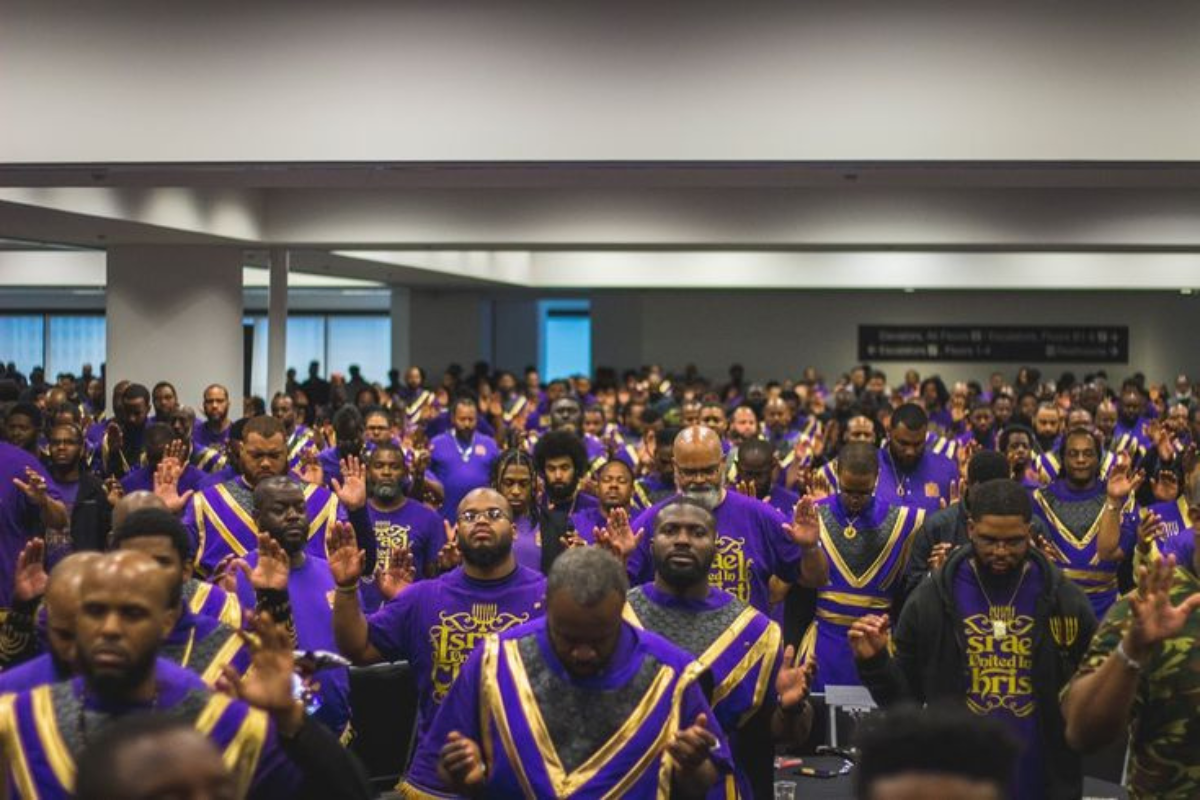
As the discussion progressed, the Hebrew Israelites shifted the focus away from Scripture and toward emotional and historical points. They brought up past injustices and cultural experiences to influence the direction of the conversation.
While those topics are serious and deserve attention, they do not determine what the Bible teaches. Emotional appeal does not establish the truth of Scripture. The text itself does.
When emotion replaces reasoning, clarity disappears. Share on X
The Christian in the discussion continually brought the focus back to the text, where the real answers are found.
 The Gospel Is for Everyone
One of the clearest points that emerged is that the message of Jesus is not limited to one group of people. The claim that salvation belongs only to a specific lineage directly contradicts the teaching of the New Testament.
“There is neither Jew nor Greek… for ye are all one in Christ Jesus.” – Galatians 3:28
The gospel reaches anyone who believes. It does not limit itself to ethnicity, background, or culture. Share on X
This truth directly opposes the exclusivity being promoted in the discussion.
This debate ultimately reveals how easily people misuse Scripture when they ignore context. They quote verses without fully understanding them, and they adjust definitions to support their arguments.
They turn to emotional appeals when the text no longer supports their claims.
When you slow down and read the Bible carefully, consistently, and in context, you remove the confusion. You see the truth clearly and directly. Share on X
If you want to see another clear example of how Scripture exposes these kinds of arguments, read the next article.
You’ll see how a careful and consistent reading of the Bible dismantles false claims and strengthens your understanding of what Scripture actually teaches.
WATCH THE VIDEO
















Recent Comments