
Orthodox Jew Admits He Won’t Follow The Bible If It Contradicts Tradition
A recent conversation with an Orthodox Jew during my livestream revealed something few outside the faith understand — that Orthodox Judaism does not always follow the Hebrew Bible directly, but often filters it through centuries of Rabbinic interpretation.
When asked a simple question —
“If the Bible says one thing and your rabbis say another, which will you follow?”
— the man didn’t hesitate. His answer was as honest as it was shocking:
“Tradition is more important than the Bible.”
That one statement perfectly summarizes the tension between Scripture and tradition within Judaism today.
For many Orthodox Jews, faith is defined not by what the Word of God says plainly, but by how the rabbis have chosen to interpret — or even redefine — it over the centuries.
 The Issue at the Heart: Can God Take on Human Form?
The discussion began with a question that has divided Jews and Christians for two thousand years: Why do Orthodox Jews reject the idea that the Messiah is God?
The caller’s response reflected a deeply rooted Rabbinic belief:
“Because God cannot take on a human form.”
But when pressed for where this idea came from, he couldn’t cite any verse from the Hebrew Bible. Instead, it came from Rabbinic teaching — not revelation.
Yet the Hebrew Scriptures show several moments when God appeared in human form. For example, in Genesis 18, Abraham encounters three men, one of whom is explicitly identified as the LORD:
“And the LORD appeared unto him in the plains of Mamre… and, lo, three men stood by him.” – Genesis 18:1–2
Abraham speaks with Him directly, calling Him Adonai (Lord), and the text makes no attempt to separate this divine visitor from God Himself. This alone contradicts the idea that God could never manifest in human form.
So if the Hebrew Bible doesn’t forbid God from taking on flesh, where did this resistance come from?
The answer lies in centuries of Rabbinic commentary that elevated man-made tradition above the plain meaning of Scripture.
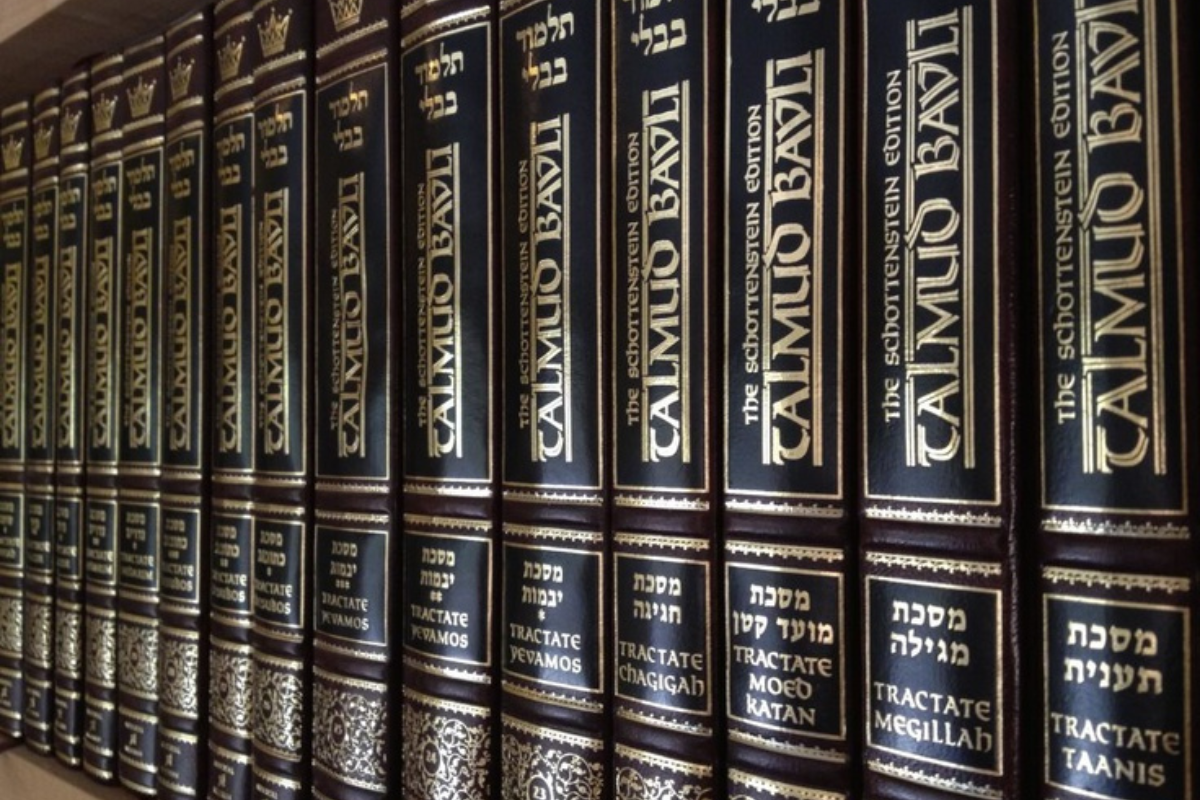 Turning to the Talmud: What the Ancient Rabbis Believed
To demonstrate that not all rabbis agreed with this modern interpretation, the discussion turned to a famous Talmudic passage — Sanhedrin 38b.
This text records a Rabbinic debate over why certain verses refer to God in the plural, such as “Let us make man in our image.” Many rabbis concluded that God was simply consulting with angels.
However, the Talmud then references a difficult passage in Daniel 7:9, where the prophet sees a vision of two thrones:
“I beheld till the thrones were cast down, and the Ancient of days did sit.” – Daniel 7:9
Why plural thrones? If there is only one God, why is Daniel describing more than one throne in heaven?
The Talmud records a fascinating answer from Rabbi Akiva, one of the most respected figures in all of Jewish history.
Rabbi Akiva interpreted this verse literally, saying that one throne was for God, and the other was for David — that is, for the Messiah.
In this view, the Messiah shares in God’s divine rule — sitting beside the “Ancient of Days.” That is no small claim.
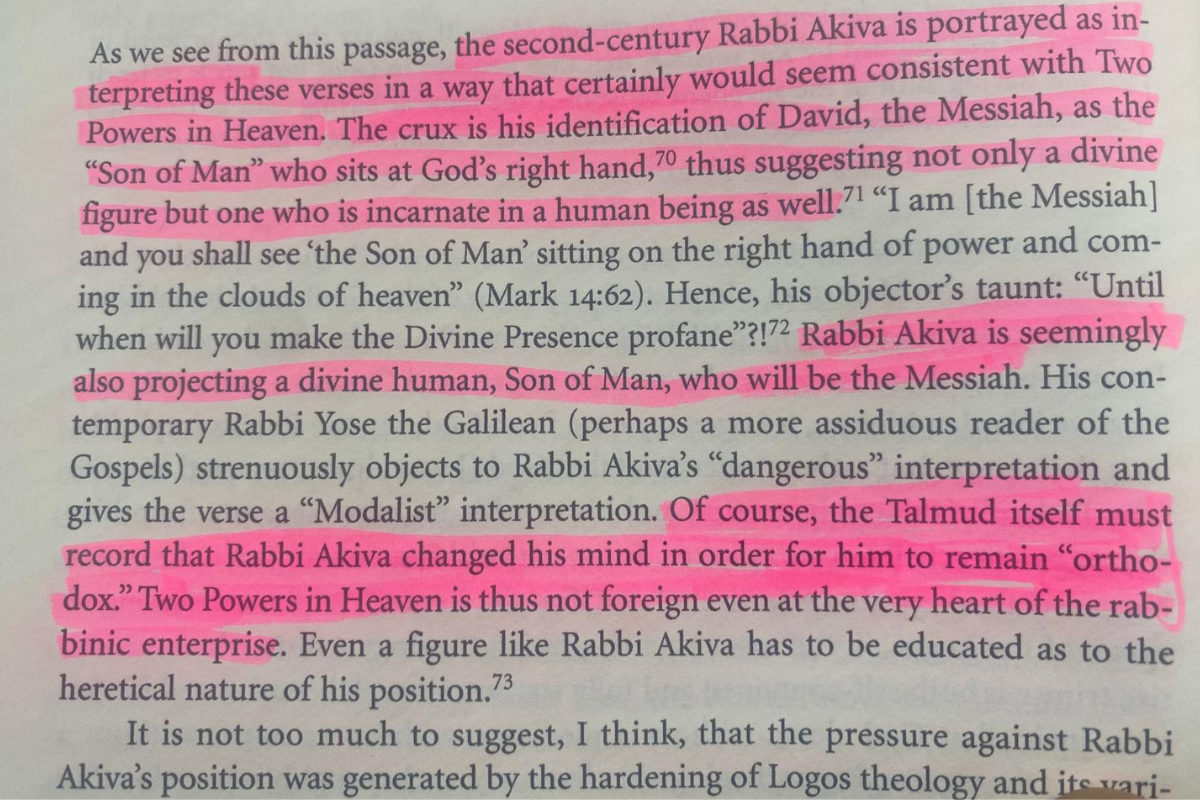 The Clash Between Two Rabbis
Rabbi Akiva’s interpretation immediately sparked controversy. Rabbi Yose, another prominent scholar, rebuked him sharply, saying,
“Akiva, how long will you desecrate the Divine Presence?”
Yose accused Akiva of blasphemy — of making the Messiah equal with God. He proposed an alternate explanation: one throne was for judgment and the other for mercy.
But even the Orthodox caller in the discussion admitted that Rabbi Akiva’s reading was more literal and “more faithful to the text.” In other words, Akiva was following Scripture as written, while others twisted it to fit their theology.
Despite that, the caller refused to accept Akiva’s view. Why? Because, he said, “It’s against Judaism to say that a person is equal to God.”
That moment revealed everything. The issue wasn’t the text — it was tradition.
Even when shown a passage where a leading rabbi and the prophet Daniel describe the Messiah in divine terms, modern Orthodox Judaism rejects it because it doesn’t fit their established framework.
 The Legacy of Rabbi Akiva
Rabbi Akiva stands as one of the most influential rabbis in Jewish history, not an obscure commentator. His teachings shape much of what people now call Orthodox Judaism.
Thousands revered him as a teacher and recognized him as a defender of Jewish law during Roman persecution.
When asked about Akiva’s significance, the Orthodox caller acknowledged his importance but quickly minimized him after hearing his interpretation.
He even claimed that Akiva’s brutal execution by the Romans was God’s punishment for “teaching against Judaism.”
History, however, tells a different story. The Romans executed Rabbi Akiva because he refused to renounce his faith, not because he taught heresy.
Dismissing his understanding of Scripture simply because it supports a divine Messiah reveals how deeply tradition can blind people to truth.
 When Tradition Becomes Law
As the discussion went on, the Orthodox caller defended his stance by appealing to Rabbinic authority:
“If the rabbis say left is right and right is left, you must follow them.”
This idea comes from Deuteronomy 17:11, which Rabbinic Judaism interprets to mean that whatever the rabbis decide becomes binding — even if it contradicts Scripture.
That interpretation has shaped Jewish thought for centuries, leading to a system where human authority outranks divine revelation.
Yet the Hebrew Bible gives a different standard:
“It is better to trust in the LORD than to put confidence in man.” – Psalm 118:8
“To the law and to the testimony: if they speak not according to this word, it is because there is no light in them.” – Isaiah 8:20
God never told His people to elevate the opinions of men above His Word. The prophets continually warned Israel against adding to or twisting what God had said.
 The Real Question
By the end of the conversation, the Orthodox caller stood firm:
“Tradition is more important than the Bible.”
It was an honest confession — but a tragic one. Because it exposes a mindset where Scripture no longer holds ultimate authority. Once human tradition becomes the standard, truth becomes negotiable.
Even the man’s reasoning revealed the depth of that mindset. He compared tradition to wheat, saying,
“God made wheat, but man uses it to make bread — to make it better.”
The implication was that rabbis “improve” the Bible through their explanations.
But as I gently pointed out, God’s Word doesn’t need improvement. It is already perfect.
Tradition can clarify; it can preserve; but it should never replace what God has already spoken. Share on X“The words of the LORD are pure words: as silver tried in a furnace of earth, purified seven times.” – Psalm 12:6
 Cling to the Bible
This discussion wasn’t about attacking Judaism — it was about revealing a sobering truth.
Even within a religion that claims to honor the Hebrew Scriptures, the authority of God’s Word can be quietly replaced by the authority of men.
When an Orthodox Jew says, “Tradition is more important than the Bible,” it’s a reminder that religion without revelation becomes hollow.
The Bible calls us back to the source — to what God actually said. Share on XIf you want to check out another discussion on a Muslim perspective, you can watch the full video here: Muslim Thinks Attacking The Bible Will Help But Gets Destroyed!
It continues the same theme — how people often try to defend tradition or belief systems that can’t stand against the clear truth of Scripture.
Whether it’s a rabbi or a Muslim apologist, the result is the same: when human reasoning clashes with God’s Word, His truth always prevails.
Because in the end, only the Word of God remains unshaken.
WATCH THE VIDEO













Recent Comments