
Luke 24:46 Explained!
One of the most overlooked statements Jesus makes after His resurrection is found in Luke 24:46.
In a single sentence, He summarizes the entire message of Scripture—His suffering, His death, and His resurrection on the third day.
For many readers, this verse raises an important question: Where exactly was this written in the Hebrew Scriptures?
To answer that, we first need to understand what Jesus is doing in this passage—and what He is not doing.
 What Jesus Means by “It Was Written”
When Jesus says these events were “written,” He isn’t referring to a single proof-text. Instead, He’s speaking the way first-century Jews understood Scripture—as a unified story told through the Law, the Prophets, and the Psalms.
Earlier in the same conversation, Jesus explains this explicitly:
“These are the words which I spake unto you, while I was yet with you, that all things must be fulfilled, which were written in the law of Moses, and in the prophets, and in the psalms, concerning me.” – Luke 24:44
This statement reflects the threefold structure of the Hebrew Bible: Torah (Law), Nevi’im (Prophets), and Ketuvim (Writings).
“Then opened he their understanding, that they might understand the scriptures, and said unto them, ‘Thus it is written, and thus it behooved Christ to suffer, and to rise from the dead the third day.’” – Luke 24:45-46
The point is not that every detail appears in one verse, but that the entire Old Testament consistently points forward to the Messiah’s mission.
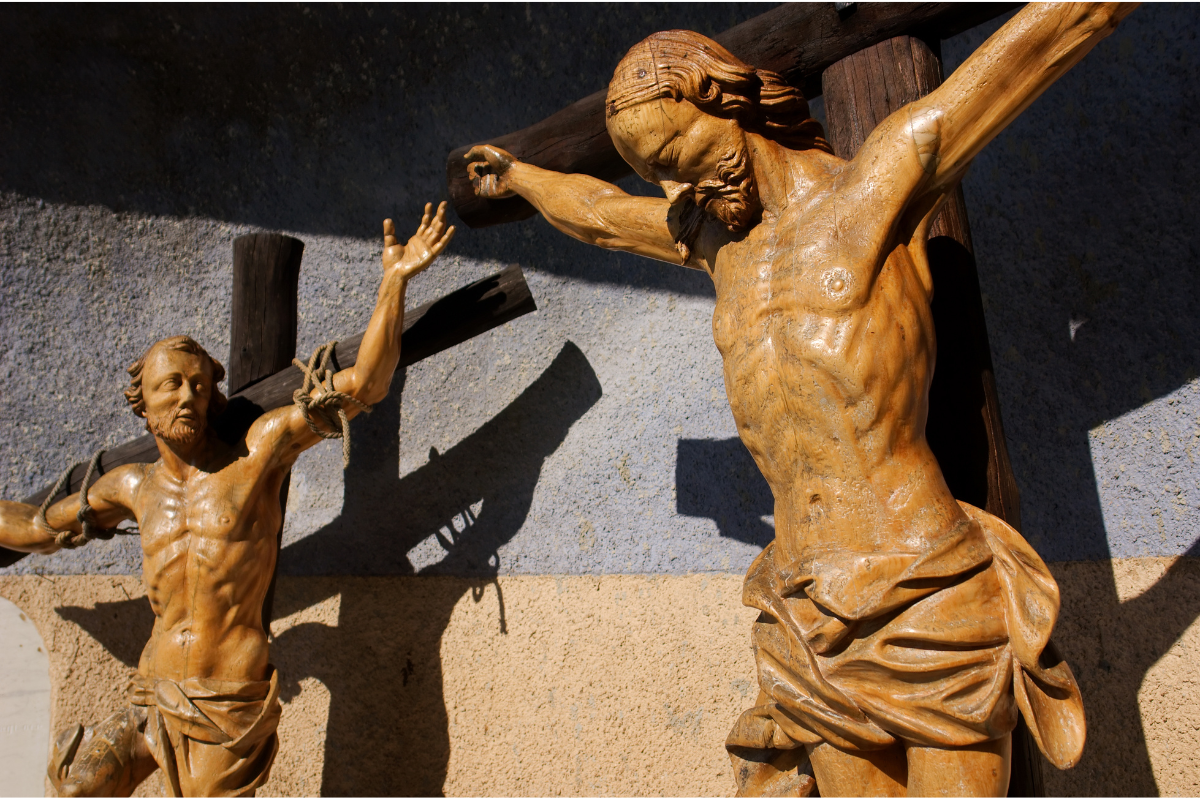 The Messiah Was Expected to Suffer
The idea of a suffering Messiah is not a Christian invention. It is deeply rooted in the Hebrew Scriptures.
“He is despised and rejected of men; a man of sorrows, and acquainted with grief.” – Isaiah 53:3
Isaiah 53 presents a servant who suffers on behalf of others, bearing guilt that is not His own. This passage alone dismantles the idea that suffering disqualifies someone from being the Messiah.
Daniel adds another crucial layer:
“And after threescore and two weeks shall Messiah be cut off, but not for himself.” – Daniel 9:26
To be “cut off” is to be killed. The text explicitly states that the Messiah’s death would be vicarious, not deserved.
Psalm 22 gives us one of the clearest Messianic portraits in all of Scripture. It is not simply a cry of despair—it is a prophetic roadmap of crucifixion.
“My God, my God, why hast thou forsaken me?” – Psalm 22:1
When Jesus quotes this psalm on the cross, He deliberately points His audience to a passage that vividly describes pierced hands, mocked faith, and public humiliation long before crucifixion was practiced.
 The Question Everyone Asks: Where Is the Third Day?
The most common objection to Luke 24:46 focuses on the resurrection timeline. Where does the Old Testament speak of the Messiah rising on the third day?
Jesus Himself gives the first answer.
Jonah: The Sign Jesus Chose
Rather than pointing to a Psalm or Prophet, Jesus highlights Jonah.
“For as Jonas was three days and three nights in the whale’s belly; so shall the Son of man be three days and three nights in the heart of the earth.” – Matthew 12:40
Jonah’s experience was not accidental. Scripture says God prepared the fish. The timing was intentional. Jonah’s descent and deliverance function as a living sign—a pattern pointing forward to something greater.
Jonah emerges alive after three days, just as Jesus would.
Jonah and the Greater Adam
There is another layer that many miss. Jonah’s story unfolds in two movements. In the first, he disobeys, flees, and brings chaos. In the second, he obeys and brings repentance and life.
This mirrors a deeper Biblical theme:
“The last Adam was made a quickening spirit.” – 1 Corinthians 15:45
Jesus is the greater Jonah—the obedient Son who accomplishes what the first Adam failed to do, extending mercy even to enemies.
The Third Day Pattern Begins in Genesis
The resurrection pattern does not start with Jonah. It begins in the very first book of the Bible.
In Genesis 22, God commands Abraham:
“Take now thy son, thine only son Isaac, whom thou lovest…” – Genesis 22:2
For three days, Abraham travels toward Mount Moriah, believing his son is as good as dead. On the third day, Isaac is given back to him alive.
“Accounting that God was able to raise him up, even from the dead; from whence also he received him in a figure.” – Hebrews 11:19
This is resurrection language—long before the empty tomb.
 Seeing Scripture the Way Jesus Taught It
Luke 24:46 is not a debate verse. It is a hermeneutical key. Jesus teaches His disciples how to read the Bible—by recognizing repeated themes, fulfilled patterns, and divine intention woven throughout the text.
The problem is not that the Old Testament is unclear. The problem is that many readers are unfamiliar with it. Share on XFirst-century Jews knew these Scriptures deeply. When Jesus connected the Law, Prophets, and Psalms to His death and resurrection, the implications were unmistakable.
The verse seems confusing; it may be because modern readers often approach Scripture in fragments rather than as a unified revelation. When read the way Jesus taught—Christ-centered and whole—the message becomes impossible to miss.
If this topic challenged or clarified your understanding, I strongly recommend reading the next article.
It expands on how Jesus’ hard sayings fit within the broader Biblical framework and helps readers interpret Scripture faithfully without stripping it from its context.
WATCH THE VIDEO















Recent Comments